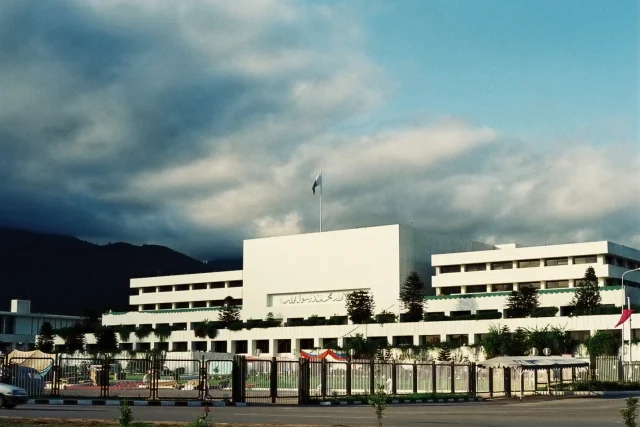
PTI Leaders Meet the Chief Justice and Ask Him to Stop “Court Packing”: The 2025 Meeting and What Became of the Courts
On 21 February 2025 the leaders of Imran Khan's party spent an hour with Chief Justice Yahya Afridi and handed him a long list of complaints, chief among them that the courts were being filled with compliant judges. This plain-English guide explains the meeting, the meaning of "court packing" and what happened to the judiciary afterwards.
About this article: It was prepared with the help of AI tools from public sources and is being reviewed by our editors. If you spot an error, please let us know so that we can correct it.
⚡ The short answer
On 21 February 2025 a delegation of the Pakistan Tehreek-e-Insaf, led by its chairman and the opposition leaders of both houses, met Chief Justice Yahya Afridi at his residence in Islamabad. They complained that court orders were being ignored, that their jailed founder was being denied his rights, that civilians were being tried by the military, and that the government was “packing” the courts: appointing and transferring judges so as to get the rulings it wanted. The chief justice listened, shared his own plan for reform and promised to act within his powers. Nine months later a constitutional amendment created a new court above his own. The changes to the courts had by then gone further than anything on the table in February.
- ✅ When: 21 February 2025, for about an hour
- ✅ Who: PTI’s chairman, both opposition leaders, its secretary general and senior lawyers
- ⚠️ Their central charge: “court packing”, which the government denies
- ✅ Afterwards: transfers upheld; a new constitutional court created in November 2025
Why a chief justice was meeting politicians
Judges do not usually invite party leaders to their homes. This meeting had a particular origin.
In early 2025 Chief Justice Afridi was preparing a meeting of the body that sets policy for the country’s courts. He decided to ask both sides of politics what they thought needed fixing. Two days before seeing the opposition, he had met the prime minister and invited the government’s suggestions. Having seen one side, he could hardly refuse the other.
So the invitation went to PTI. Its chairman, the lawyer Gohar Ali Khan, was careful to tell reporters afterwards that the party had come because it was asked.
The party had its own reasons for accepting. Its founder had been in prison for eighteen months. Its petitions were going unheard or being dismissed. And three weeks earlier, changes to the benches of two courts had convinced it that the game was being fixed. A meeting with the chief justice was a chance to say so to his face.
The government had come to the chief justice with suggestions. The opposition came with accusations. He received both with the same courtesy, which told each side less than it hoped.
What was said
The delegation
Those reported present included the most senior figures the party had at liberty.
| Name | Position at the time |
|---|---|
| Gohar Ali Khan | Chairman of the party |
| Omar Ayub Khan | Leader of the Opposition, National Assembly |
| Shibli Faraz | Leader of the Opposition, Senate |
| Salman Akram Raja | Secretary general; a senior lawyer |
| Ali Zafar | Senator; a member of the Judicial Commission |
| Latif Khosa | Member of the National Assembly; a former governor and senior lawyer |
The complaints
By the delegation’s own account to reporters, it raised six matters.
- Court orders ignored. Orders allowing Imran Khan to meet his lawyers, family and party leaders were, they said, routinely disobeyed by the prison authorities.
- Prison conditions. They alleged he was kept in isolation and denied proper medical attention. The government has consistently said he receives better facilities than any other prisoner.
- Military trials. Civilians accused over the riots of 9 May 2023 were being tried in military courts.
- Disappearances. Party workers and others had been picked up without charge.
- Production orders. Jailed members of Parliament were not being brought to sittings despite orders from the presiding officers.
- The courts themselves. One of the lawyers in the delegation criticised what he called attempts to fill the courts with politically aligned judges, and asked for action on a complaint made by judges of the Islamabad High Court about interference in their work. He is reported to have told the chief justice that the judiciary needed to put its own house in order first.
The reply
The chief justice did not argue. According to those present:
- he shared a ten-point agenda for judicial reform and asked the party to send written recommendations;
- he said he would do what was appropriate within his constitutional authority;
- he told them that a long letter from Mr Khan, running to several hundred pages, had been passed to the committee of judges that decides which cases the constitutional bench will hear.
In other remarks around that time he rejected the suggestion that the courts were being packed.
What “court packing” means
The phrase comes from the United States. In 1937 President Franklin Roosevelt, angry that the Supreme Court kept striking down his laws, proposed to add up to six new judges of his own choosing. The plan failed. The name stuck.
It now means any attempt by those in power to change who sits on a court in order to change how it rules. There are several ways to do it.
| Method | How it works |
|---|---|
| Adding seats | Enlarge the court and fill the new places |
| Controlling appointments | Change who chooses the judges |
| Transfers | Move judges between courts to alter seniority or the make-up of a bench |
| Choosing the benches | Decide which judges hear which cases |
| Creating a new court | Move the important cases to a body staffed from scratch |
| Removing judges | By lowering the retirement age, or through disciplinary proceedings |
No one admits to packing a court. Every government that has done any of these things has described it as reform. The question is always whether the change would have been made if the judges had been ruling the other way.
💡 Tip: how judges are appointed in Pakistan
Judges of the Supreme Court and the high courts are chosen by the Judicial Commission of Pakistan. Until 2024 judges held the majority on it. The 26th Amendment changed its membership to include, alongside the chief justice and senior judges, the law minister, the attorney general, a representative of the bar, and four members of Parliament, two from the government and two from the opposition, plus a nominee of the Speaker. Judges are now a minority. Supporters call this democratic oversight. Critics say it gives the executive and its allies the casting vote. Read more about Parliament’s role in our explainers on the National Assembly and the Senate.
The events that provoked the charge
PTI’s accusation in February 2025 rested on four things that had happened in the previous four months.
1. The 26th Amendment (October 2024)
- The chief justice would no longer be the most senior judge automatically. A parliamentary committee would pick from the three most senior. Under the new rule, the two judges senior to Justice Afridi were passed over.
- Constitutional cases would go to special constitutional benches, whose members the reshaped Commission would choose.
- The Commission itself was remade, as described above.
2. Three judges moved to Islamabad (1 February 2025)
The Islamabad High Court hears most cases concerning the federal government, and Mr Khan’s appeals. On 1 February 2025 the president transferred three judges to it, one each from the high courts of Lahore, Sindh and Balochistan.
A new seniority list then placed one of the newcomers, a judge from Lahore, second only to the chief justice of that court, ahead of judges who had sat there for years. Within days he was its acting chief justice.
Five judges of the Islamabad High Court objected in writing. They argued that a transferred judge must take a fresh oath and go to the bottom of the list. Four judges of the Supreme Court wrote in support of delay.
To PTI the purpose was obvious: to change who would lead the court that mattered most to it. The government said that the Constitution has always allowed such transfers, that they brought judges from under-represented provinces to the federal capital’s court, and that seniority follows the date of first appointment.
3. Six new Supreme Court judges (10 February 2025)
Nine days later the Commission met to fill vacancies on the Supreme Court. PTI’s member, Senator Ali Zafar, wrote asking that the meeting be put off until the Islamabad seniority dispute was settled. It went ahead. PTI’s members and two of the most senior Supreme Court judges boycotted it. Six new judges were approved.
4. The earlier letter
In March 2024, six judges of the Islamabad High Court had written an extraordinary letter alleging that intelligence agencies were interfering in their work through pressure on them and their families. The matter was taken up by the Supreme Court and never fully resolved. PTI wanted it reopened.
Each side’s case
| Question | PTI’s case | The government’s case |
|---|---|---|
| Why change how judges are chosen? | To get judges who will rule for the government | Parliament, not judges, should have the main say, as in many democracies |
| Why transfer judges to Islamabad? | To alter the leadership of the court hearing Mr Khan’s cases | The Constitution allows it; the capital’s court should reflect the federation |
| Why constitutional benches? | To take key cases away from independent judges | The Supreme Court was overloaded; a specialist bench is more efficient |
| Is the judiciary independent? | No longer | Yes; PTI simply dislikes losing |
| What is the remedy? | Undo the amendment; restore seniority | Accept the law as passed by a two-thirds majority |
There is a further point that fair-minded observers on both sides concede. When PTI was in government it, too, was accused of leaning on judges and of benefiting from benches chosen to its advantage. Its opponents have not forgotten. The independence of the courts has been defended most loudly, at any given time, by whoever was out of power.
⚠️ An accusation is not a finding
No court has held that Pakistan’s courts were “packed”. The changes described here were made by constitutional amendment, by presidential order under an existing article and by majority vote of the body the Constitution appoints for the purpose. Their legality has been upheld where it has been tested. Whether they were wise, and what they were for, is a matter of political judgment on which the parties disagree completely. This article reports the charge and the answer. It does not decide between them.
What happened afterwards
To the transfers
The five Islamabad judges took their objection to the Supreme Court. In June 2025 its constitutional bench, by a majority, upheld the transfers and left the question of seniority to the president. The transferred judge from Lahore was confirmed as chief justice of the Islamabad High Court the following month.
To the party’s leaders
Of the six men named above:
- two, Omar Ayub Khan and Shibli Faraz, were convicted by an anti-terrorism court in July 2025 over the events of 9 May 2023, sentenced to ten years and disqualified from Parliament. Both said the cases were political and appealed.
- the others remained at liberty and continued to lead the party’s legal and political efforts.
To the Supreme Court
The largest change was still to come. In November 2025 the governing coalition, by then holding two-thirds of both houses, passed the 27th Amendment.
| Before November 2025 | After | |
|---|---|---|
| Final court for constitutional questions | The Supreme Court, through its constitutional benches | A new Federal Constitutional Court |
| The Supreme Court | The apex court | The final court for ordinary civil and criminal appeals |
| Chief Justice Afridi | Head of the country’s top court | Head of a Supreme Court with narrower powers |
| Transfers of high court judges | By the president, after consultation | On the Commission’s recommendation, without the judge’s consent |
Two senior judges of the Supreme Court, Justice Mansoor Ali Shah and Justice Athar Minallah, resigned within hours of the amendment becoming law. Justice Shah had been the most senior judge when the chief justiceship was decided in 2024 and was passed over; he had also boycotted the Commission’s meeting in February. A judge of the Lahore High Court followed.
The government said the letters of resignation did not point to anything in the amendment that offended the Constitution.
To the meeting’s promise
The reform agenda the chief justice shared in February 2025 dealt with delays, case management, district courts and technology. Some of it has been carried out. It did not, and could not, address what the delegation had come about.
What a chief justice can and cannot do
The delegation asked Chief Justice Afridi to stop something. It is worth being clear about his powers.
| He can | He cannot |
|---|---|
| Chair the Judicial Commission | Outvote its majority |
| Manage the Supreme Court’s administration | Decide alone which judges hear constitutional cases; a committee does |
| Speak for the judiciary | Refuse to apply a constitutional amendment |
| Refer complaints against judges | Block a presidential transfer order |
| Take up matters of public importance, within limits set in 2024 | Reverse an Act of Parliament by himself |
He was, in short, being asked to defend an independence that the Constitution, as amended, had already redistributed. His critics say he could have done more by speaking out. His defenders say a judge who campaigns against Parliament’s amendments stops being a judge.
Why it matters beyond one party
For anyone who goes to court. A citizen suing the government, or accused by it, needs a judge who is not looking over his shoulder. That is as true for a farmer in a land dispute as for a former prime minister.
For investors. Businesses decide where to put money partly on whether contracts will be enforced against the state.
For the next government. Rules made to restrain today’s opposition will be available to whoever governs tomorrow. Parties that cheered the weakening of the courts have, in Pakistan’s history, usually lived to regret it.
For the judges. A bench that is seen as chosen for its views loses authority even when it rules correctly.
✅ Key point
The meeting of 21 February 2025 was polite, and changed nothing. The party that came to complain of “court packing” was describing, as it saw things, the first steps of a process. By the end of the year that process had produced a new court, a narrower Supreme Court and the resignation of two of its senior judges. Whether that was the capture of the judiciary or its long-overdue reform is the question on which Pakistani politics now divides.
Words used in this article
| Term | Plain meaning |
|---|---|
| Chief Justice of Pakistan | The head of the Supreme Court |
| Court packing | Changing who sits on a court in order to change its rulings |
| Judicial Commission of Pakistan | The body that selects judges of the superior courts |
| Constitutional bench | A panel of judges assigned to constitutional cases |
| Federal Constitutional Court | The court created in November 2025 for constitutional questions |
| Seniority | A judge’s rank, by date of appointment, which decides who becomes chief justice |
| Transfer | Moving a judge from one high court to another |
| Production order | An order that a jailed member of Parliament be brought to a sitting |
| Enforced disappearance | Detention by the state that the state does not acknowledge |
| Boycott | Refusing to attend, as a protest |
Timeline
| Date | Event |
|---|---|
| March 2024 | Six Islamabad High Court judges write alleging interference |
| October 2024 | 26th Amendment; Justice Yahya Afridi becomes chief justice |
| 1 February 2025 | Three judges transferred to the Islamabad High Court |
| Early February 2025 | Judges and PTI ask for the Commission’s meeting to be postponed |
| 10 February 2025 | Six Supreme Court judges approved amid a boycott |
| About 19 February 2025 | The chief justice meets the prime minister |
| 21 February 2025 | The chief justice meets PTI’s leaders |
| June 2025 | The Supreme Court’s constitutional bench upholds the transfers |
| July 2025 | Two members of the delegation are convicted and later disqualified |
| 13 November 2025 | 27th Amendment; two Supreme Court judges resign |
For the background, read our guide to Pakistan’s politics and our explainer on the vote of no confidence.
Understand how Pakistan's institutions work
PoliticsPK explains who is who, how the system works and what changes, without the noise.
More in Pakistan Politics Politics Explained Latest from PoliticsPK
Frequently asked questions
❓ When did PTI leaders meet the chief justice?
On 21 February 2025, at Chief Justice Yahya Afridi’s residence in Islamabad. The meeting lasted about an hour.
❓ Who attended?
The party’s chairman Gohar Ali Khan, the opposition leaders Omar Ayub Khan and Shibli Faraz, secretary general Salman Akram Raja, Senator Ali Zafar, Latif Khosa and others.
❓ What is court packing?
Changing the membership of a court, for example by adding, transferring or selecting judges, in order to influence its decisions. The term comes from a failed American plan of 1937.
❓ Did the chief justice agree that courts were being packed?
No. He is reported to have rejected the charge. At the meeting he shared a reform agenda and said he would act within his constitutional authority.
❓ Why did PTI make the accusation?
Because of the 26th Amendment, the transfer of three judges to the Islamabad High Court in February 2025 and the appointment of six Supreme Court judges at a meeting its members boycotted.
❓ What happened to the transferred judges?
The Supreme Court’s constitutional bench upheld the transfers in June 2025, and one of them became chief justice of the Islamabad High Court.
❓ What is the Judicial Commission of Pakistan?
The body that selects judges of the Supreme Court and high courts. Since October 2024 it has included members of Parliament and judges are in the minority.
❓ What did the 27th Amendment do to the Supreme Court?
It moved constitutional cases to a new Federal Constitutional Court, leaving the Supreme Court as the final court for ordinary appeals.
❓ Why did two Supreme Court judges resign in November 2025?
Justices Mansoor Ali Shah and Athar Minallah resigned in protest at the 27th Amendment, which they said undermined the court. The government rejected that view.
Sources
- Aaj English, “PTI leaders meet chief justice, raise a barrage of complaints” — 21 February 2025.
- Dunya News, “PTI apprises CJP Yahya Afridi of ills plaguing country: Omar Ayub” — February 2025.
- The Express Tribune, “PTI delegation calls on CJP Afridi, suggests reforms for judiciary” — February 2025.
- Dawn, “PTI requests CJP Afridi to postpone JCP meeting scheduled for tomorrow” — 9 February 2025.
- Geo News, “CJP Afridi forwards Imran’s letter to constitutional committee” — February 2025.
- Daily Pakistan, “Justice Sarfraz Dogar named senior most judge of Islamabad High Court” — 29 June 2025.
- Arab News, “Two Pakistan top court judges resign in protest as 27th constitutional amendment becomes law” — November 2025.
- Supreme Court of Pakistan — for press releases and judgments.